


Warren Buffett is often hailed as the greatest investor of all time. Every MBA student makes the pilgrimage to Omaha as a rite of passage. Some make reading every one of his shareholder letters their whole personality. Have they not noticed that his investment returns tracked the S&P 500 over the last 20 years?
Don’t get me wrong. There is a lot we can learn from him. He has shared much wisdom that still holds true today.
He preached stoicism: a trait many investors would enjoy adopting.
“If you can’t control your emotions, you can’t control your money.”
“Be fearful when others are greedy and greedy when others are fearful.”
“The most important quality for an investor is temperament, not intellect.”
But study the methods he used to achieve his success, and you may find the opportunity has evaporated.
His track record
Buffett graduated from University of Nebraska in 1950 with a B.S. in Business Administration. He then earned an M.S. in Economics in 1951 from Columbia Business School. He went to work at father’s firm, Buffett-Falk & Co. as a securities salesman. After a few years, he returned to New York, taking a position at Graham-Newman Corporation as a securities analyst.
In 1956, Buffett returned to Omaha and started his own investment firm. He raised $105,100 from family and friends, plus $100 of his own money. Additional single-family partnerships brought the total assets under management to $303,726 ($3,674,997 in today’s dollars).
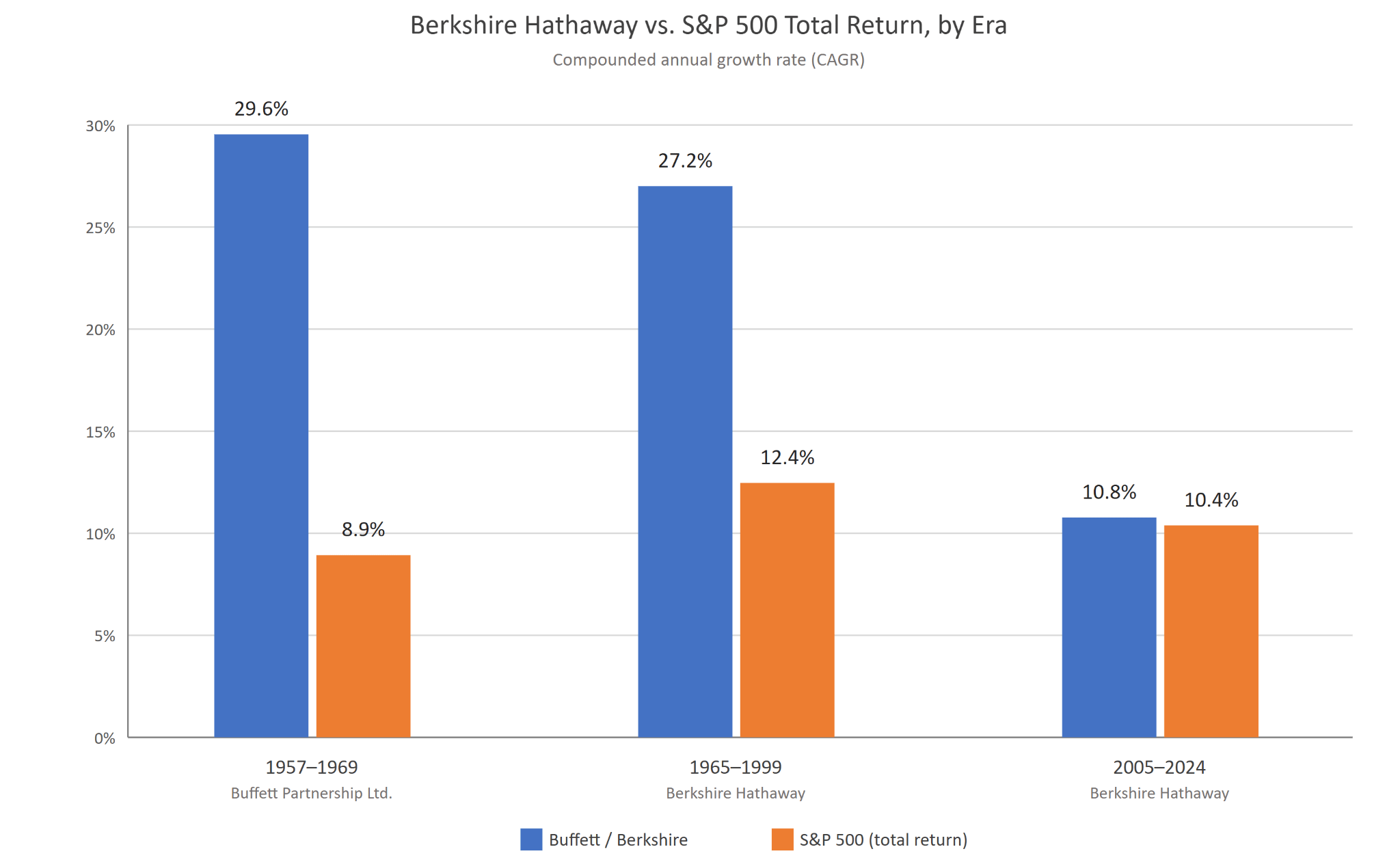
During those early partnership years, he achieved returns of ~29% annually. After taking control of Berkshire Hathaway in 1965, Berkshire compounded around ~27% from 1965 through 1999. For the last 20 years, he’s roughly tracked with the S&P 500.
The edge behind his returns
Investment research was a different animal pre-2000. An analyst would simply go meet with management, ask how business has been lately, and then use that information to inform their trades. They called this method “scuttlebutt.”
Passed in 2000, Regulation FD banned companies from feeding information to some analysts but not to others. Today, the market has rules around public dissemination. When a CEO shares information about how business has been lately, they must say it publicly so all investors hear it at the same time.
This part of Buffett’s strategy – the access edge – cannot be replicated in today’s stock market.
He also traded on an obscurity edge. Buffett has said if he were working with $1 million today, he could “guarantee” a ~50% annual return, because tiny, illiquid, uncovered stocks are where real mispricings persist. That’s an advantage available to any individual investor willing to put in the research. The whole small-cap market is open to you in a way it isn’t to large funds.
He was known for hand-collecting data on tiny stocks that no one bothered looking at. This could still be replicated today. You can run a screen for micro-cap stocks too small for institutions to own and too small for analysts to cover. However, less asymmetry exists today than in 1950. Online stock screeners make this easily visible to everyone, thus eliminating most obvious arbitrage opportunities.
The other edge Buffett possessed is a behavioral one. This one is fully replicable.
What his letters actually teach
If you read the letters to shareholders written by Buffett, you would walk away with these core principles.
Invest in excellent businesses at good prices. Don’t invest in mediocre businesses at great prices. Quality is essential.
Temperament beats intellect. Control your emotions, or else your emotions will control your money, and the market will punish that.
Compounding requires doing nothing. Place trades infrequently and be patient for decades. This is where the magic happens.
He is a big fan of durable competitive moats, high returns on capital, honest and able management, understandable businesses, real cash generation, buying with a margin of safety, extreme concentration, and near-permanent holding periods.
Should you copy his portfolio?
If you sat down with Warren Buffett and asked him for investing advice, he wouldn’t point you to his portfolio as inspiration. He would not hand you a strategy for picking or analyzing stocks.
He would tell you to invest in a low-cost index fund.
I agree that, for most people, low-cost index funds are the right strategy. Picking stocks is a full-time job and most underestimate how time consuming it is to do it properly.
I’d also caution that there is no such thing as a perfect investment. There are only those that fit your risk tolerance, time horizon, and goals better or worse. Buffett is 95 years old and has a net worth of $147 billion. His strategy is naturally going to look different than, say, a 30-year-old investing $100,000. He has a much different objective – capital preservation and legacy, not growth. That’s why his portfolio holds stable, large cap companies with dividend payouts. That same portfolio would likely make far less sense for someone younger, whose main objective is growth.
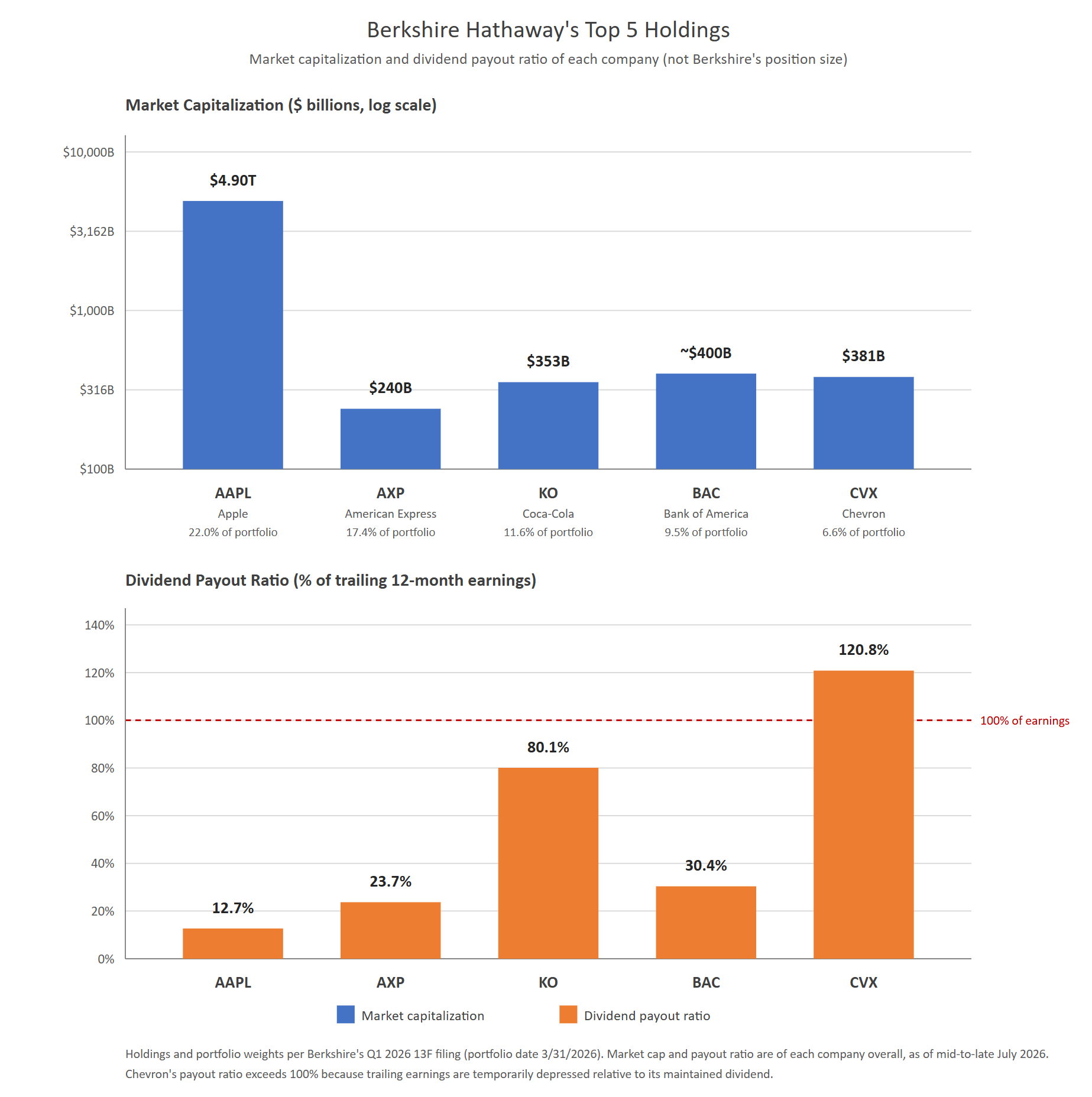
Buffett has long had a reputation for avoiding investing in technology companies. His philosophy is to stay within your circle of competence and only invest in businesses you understand. He was slow to invest in Apple, which ended up being his best investment of all time once he eventually bit the bullet. He missed out on companies like Nvidia, which grew 87x over the last decade, and Tesla, which grew 44x. Avoid tech investing at your own peril.
Learn from his philosophy, but don’t copy his strategy.
Other investing role models
There’s more wisdom out there than one shareholder letter collection. Here’s a list to get you started.
1. Lee Freeman-Shor - The Art of Execution
This book analyzes what elite fund managers’ actual trades revealed vs. what their stated philosophies were. It found that position management mattered more than idea quality. It teaches concrete rules for adding, holding, and exiting a position.
2. Chris Mayer - 100 Baggers
A systematic study of stocks that returned 100x outcomes. It teaches the statistical profile of companies early enough to compound 100x (small, high ROIC, reinvestment runway, owner-operators), and why selling winners too early is an expensive habit.
3. Carlota Perez - Technological Revolutions and Financial Capital
The theory behind megatrend investing. It outlines the phases of a big technological advancement, from irruption to frenzy to crash, and eventually to maturity. It’s useful for placing any technology, AI included, on that cycle. Her papers and talks are available here.
4. Howard Marks - Memos + Mastering the Market Cycle
He teaches you to think in probabilities and find where you are in the market cycle. Memos are available for free at oaktreecapital.com.
5. Nick Sleep - The Nomad Partnership Letters
His fund invested in 2-3 retailer stocks, when everyone else believed they were overvalued. He held through the noise and stood firm in his conviction. Once he ran out of new ideas, he closed the fund. A full collection of his letters is available here.
6. Stanley Druckenmiller - Interviews & Speeches
His investment style is very flexible. He will invest in currencies, bonds, or equities depending on what the macro backdrop rewards. Here’s a more recent long-form interview he gave.
7. Li Lu - Columbia Lectures + Essays
As a modern-day value investor, his hedge fund has reportedly returned a 30% compound annual return since 1998. His Columbia University lectures are available on youtube.
8. Annie Duke - Thinking in Bets + Quit
As a former professional poker player, she teaches you to separate good decisions from good outcomes. You can make the right call and still lose, or the wrong call and still win. Also makes the case that quitting on time is a skill, not a failure.
9. Nassim Taleb - Fooled by Randomness
Rare, high-impact events dominate outcomes far more than most people’s models assume.
10. You - Yes, you.
One of the best ways to learn and improve your own style as an investor is to keep a written journal on your trades. Document your thesis. Analyze your errors and your wins. Write an annual investor letter to yourself.
Buffett used to ask business students to perform a mental exercise. You can buy 10% of the lifetime earnings of one of your classmates. Who would you choose? What traits does that person possess that makes you choose them? Perhaps characteristics like integrity, generosity, or good judgement. Then he would point out that these are traits you can nurture in yourself. You owe it to yourself to become the person worth betting on.