


I built a Portfolio Allocation Tool to help me construct the highest-growth portfolio. After exploring all allocation options, it kept pushing me to add leverage rather than volatility.
Volatility doesn’t necessarily increase growth. It widens the possible range of outcomes. Compounding is geometric, not arithmetic. That’s why more volatility often leads to worse outcomes. So “high risk = high reward” is mostly a myth we tell ourselves.
A better way to get high growth is to add leverage to a lower-volatility portfolio.
The search for cheap leverage
I found very few borrowing options available to individual investors. Most of them did not make financial sense. To profit from leverage, you need to borrow at a rate that is substantially lower than the investment’s expected return. Analysts project the U.S. stock market will grow at 6.7%. Almost no one will lend to an individual investor meaningfully below that rate.
Most brokerage margin accounts run in the low double digits range. Even cheaper brokers still land in the mid-single digits depending on balance.
I checked low-interest personal loans. They explicitly restrict what the proceeds can be used for and don’t allow securities investing.
It took some digging, but I found a few viable options where leverage is attainable at a rate that makes sense.
Real estate comparison
I would argue that most of what makes real estate investing attractive is actually just leverage. No other asset class that retail investors can access offers the debt terms that real estate does. Without debt, real estate is a lot less accessible and a lot less attractive to retail investors.
Real estate also tends to be a less volatile asset than stocks. Huge drops in value are less common. Which makes the use of leverage less intimidating.
Housing is a less-frequently-priced asset. Stocks get repriced every day the stock market is open. But houses only get repriced when they are bought, sold, or appraised. The volatility still exists. You just don’t see it when the asset gets repriced that infrequently.
More importantly, your mortgage does not get marked to market. Your mortgage doesn’t get called in simply because your home’s value drops, as long as you keep making payments. When you apply debt to a stock portfolio, a decline in the value of the underlying assets can trigger a margin call directly.
Why use leverage at all
Top investors, like Warren Buffett, used leverage to achieve outstanding returns. Research on Berkshire Hathaway estimates Buffett ran the portfolio at roughly 1.6-to-1 leverage on average. That leverage came almost entirely from insurance float, not from margin debt. Float isn’t marked to market and can’t be called the way a margin loan can. It’s a safer form of leverage than what is available to an individual investor. Nevertheless, the underlying principle holds. Applying leverage to a lower-volatility, high-quality portfolio helped Buffett generate outsized returns.
Options for individual investors
Most low-interest loans specify that you can’t use the proceeds for speculative investing, and standard brokerage margins are typically priced high.
A couple other options exist.
ETFs with leverage built in. Funds like RSSB or NTSX hold a base of equities and Treasury futures to create capital-efficient leverage. The leverage lives inside the fund, so there is no margin call risk to the investor personally. RSSB launched in 2023, so performance data is limited. Worst case scenario, stocks and bonds move in the wrong direction at the same time. This happened in 2022 and NTSX declined -30%, compared to -24% for the S&P 500.
Box spread loans. This may be appropriate if you have a high brokerage balance and experience with trading options. Box spread loans typically reflect Treasury rates plus a small margin. This more closely reflects the rates institutional investors have access to. They are currently trending around 4-5%, even for long duration loans.
Setting up the box spread
I recently took out a box spread loan through my brokerage, Charles Schwab. To do it, I needed approval for the right level of options trading. I could only place the trade through their thinkorswim platform. I used ToS’ paperMoney simulator to practice placing the trade beforehand, and used AI to double check I had set it up correctly. This is something where you can absolutely get burned if you don’t know what you’re doing. Brokerages gatekeep advanced options trading strategies for a reason.
I used SyntheticFI to track rates before committing.
One thing worth knowing going in: there is a difference between American-style and European-style options.
American-style options can be exercised any time before expiration, creating early assignment risk. Your position can get called away unexpectedly, as one guy learned the hard way.
European-style options (including index options like SPX and XSP) only exercise at expiration, avoiding that risk entirely. You are paid upfront, and the trade settles in cash at expiration.
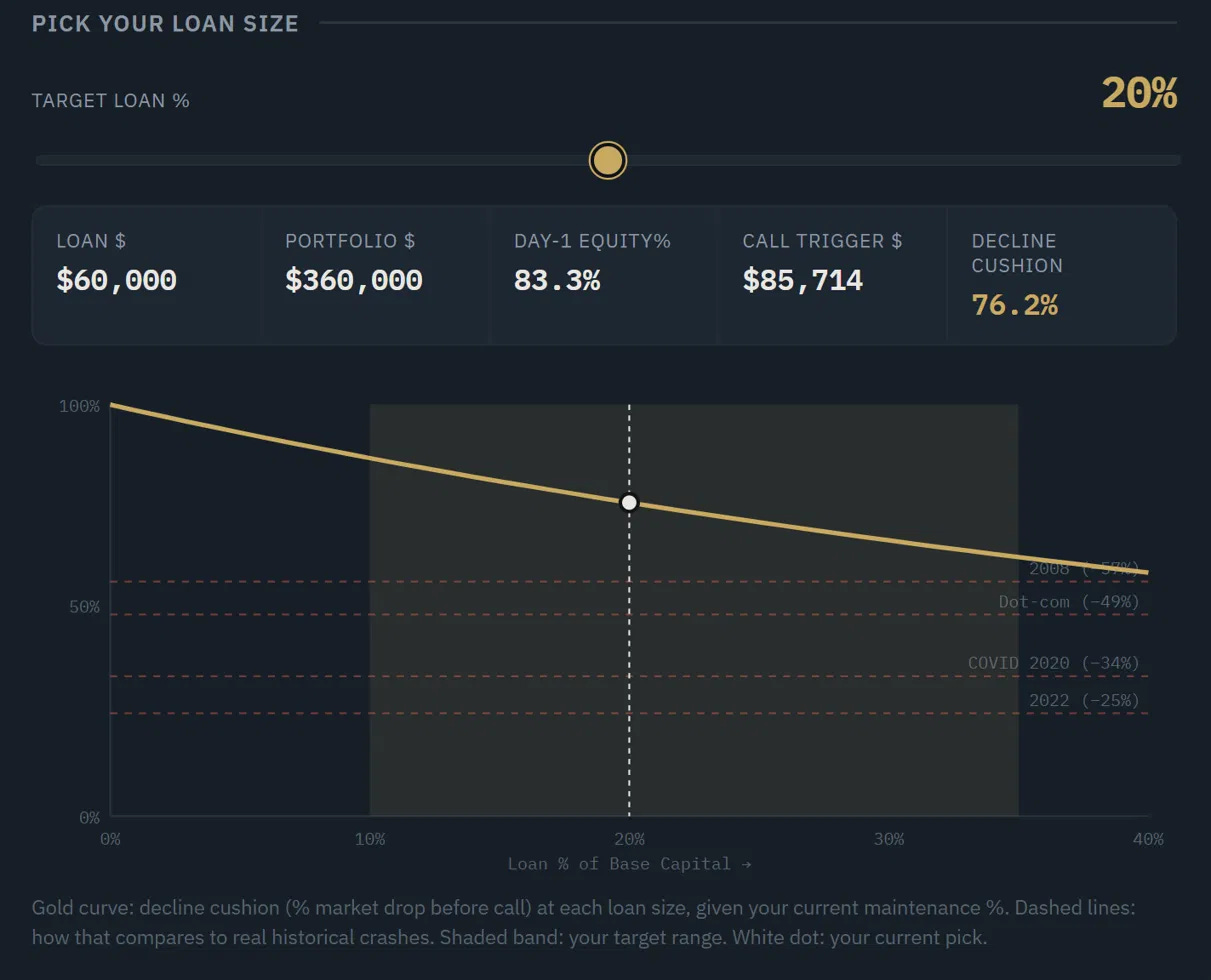
I built out a Google Sheets model to size and set up the trade. I used Claude to build a small interactive tool to model decline cushions against different loan sizes.
Once my order was filled and I received the cash, I invested it in ETFs that align with my investment goals.
When my loan comes due in September 2027, I can either cover it by selling assets or by taking out a new box spread loan. There is a rollover risk at this point. If both asset prices are down and interest rates are substantially higher, I could be forced to sell at a bad time or refinance at a much worse rate.
Since a box spread nets out as a gain or loss on options contracts, the “interest” is treated as a capital loss. That could be used to offset capital gains for tax purposes.
Sizing the loan: stress testing
Before committing to a size, I ran the numbers against how bad past market declines have actually been.
2008 -57%
The dot com crash -49%
COVID 2020 -34%
2022 -25%
I used this to model at what point a decline would trigger a maintenance margin call, given my portfolio size and maintenance requirement.
At my chosen loan size (~31% of my pre-loan portfolio value), the portfolio could decline roughly 66% before triggering a margin call. This would be beyond any of the historical drawdowns in the last 50 years, so, unlikely.
The cushion assumes that the maintenance requirement stays fixed. The brokerages set these requirements and adjust them at their discretion. They typically raise house maintenance requirements during periods of high volatility.
Where this leaves us
I’ll be tracking the performance of what I invested in with my box spread loan and see how well the returns compare to the cost of borrowing. Follow along to see how it does.