


We are experiencing a technological revolution. Perhaps it is unlike any other one. Or perhaps it’s just like every other one.
I hear a lot of comparisons of AI to the internet and of the economics of AI to the dot-com bubble. I see corporate executives investing billions into building AI systems for their companies. At the same time, they are paying billions in severance to part ways with their human employees.
I started using AI pretty early on. I questioned ChatGPT with doubt when it first came out. My first prompt asked it to write a real estate listing for my house. I was amazed at how good it sounded, considering how little information I provided. I swore I would never need a realtor again.
Yet the more I used AI, the more errors I found it making. By the time I’d spent hundreds of hours with it, I hardly trusted it with simple tasks. It sounds confident but makes basic errors. These errors are hard to catch because they seem random. I learned to check every step before mistakes could compound. I became cynical. How can an executive trust AI to run a company? I can’t even trust it to find a good restaurant!
I’ve come to think there’s an S-curve to using AI. It mirrors Gartner’s Hype Cycle: Peak of Inflated Expectations → Trough of Disillusionment → Slope of Enlightenment → Plateau of Productivity. For the first 100 hours, you think it’s amazing and capable and eagerly hand it tasks. For the next 100 hours, you don’t trust it to do anything right. Eventually, you settle somewhere in the middle. You understand the difference between what it excels at and where its blind spots are.
As we examine the valuations of AI companies, we need to consider where the market stands in that cycle. Does the market think too much of AI, or not enough?
I dug into the numbers. My conclusion is that AI is a real economic transformation, and the market as a whole is not a bubble. Localized bubbles exist in certain companies and financing structures. Insiders even acknowledge this. Sam Altman has said, “someone is going to lose a phenomenal amount of money.” Some high-quality companies seem temporarily discounted due to AI fear. I believe this mispricing deserves its own focus.
How value gets priced
A company’s value is the net present value of its future cash flows. P/E multiples are shorthand for that equation:
Stock Price = Earnings per Share × P/E Multiplier
AI boosts earnings in two ways:
Directly through new products and better pricing
Indirectly by reducing errors and cutting costs
A high multiple isn’t automatically irrational. It’s a claim about future growth and durability. The question is whether the company lives up to it.
Is there real demand?
The first indicator of a bubble is that there’s no demand. Flash back to the early 2000s, when companies like Pets.com and eToys imploded. These businesses burned through cash on customer acquisition but never found a path to profitable earnings. The companies we are examining today have established businesses and generate real earnings.
Analysts now expect the top five hyperscalers to spend $697 billion on AI infrastructure this year, with Goldman Sachs projecting $5.3 trillion by 2030. J.P. Morgan banker John Servidea called AI financing “the biggest secular theme in our professional lifetimes.”
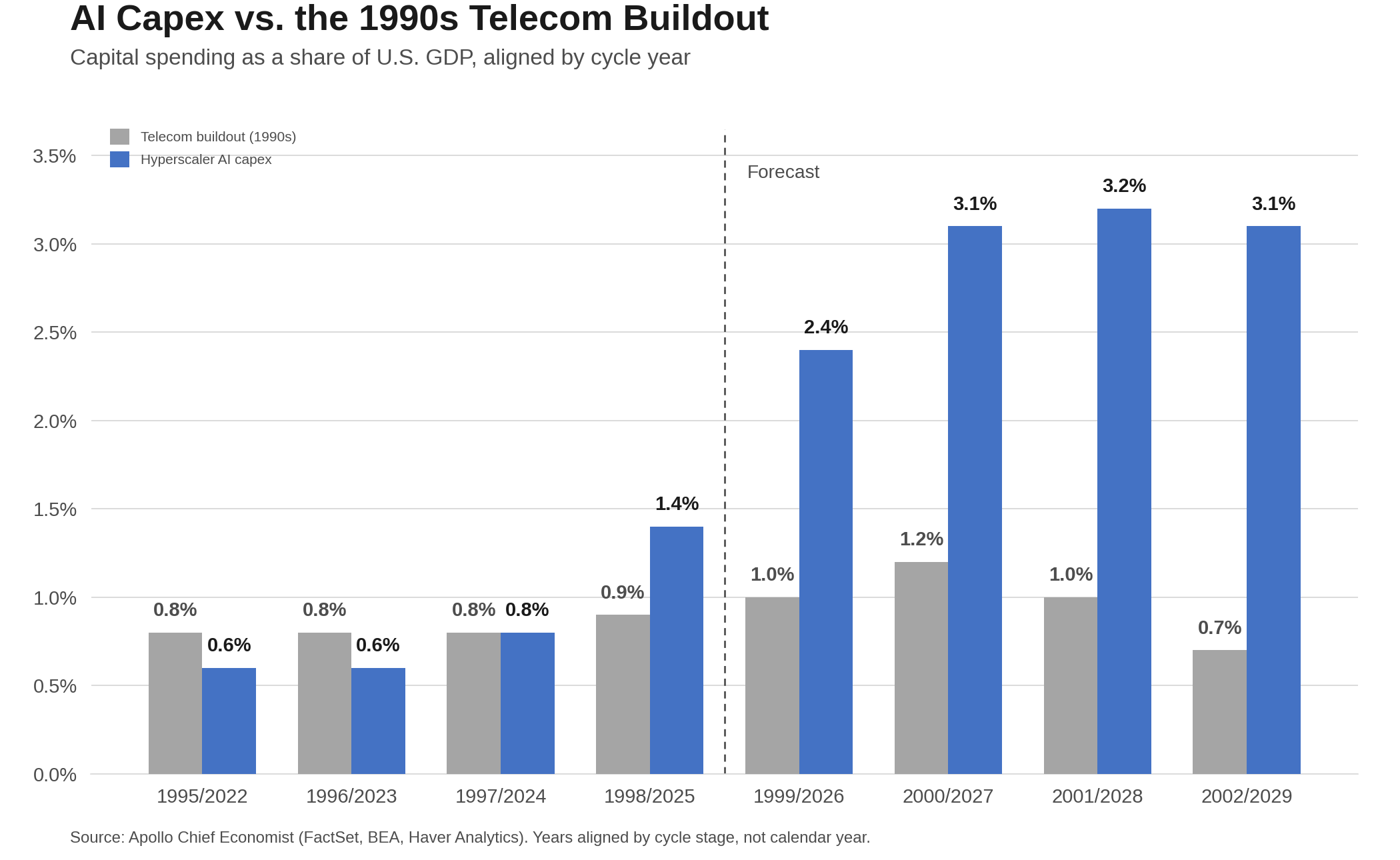
The spending on AI infrastructure already exceeds the 1990s telecom and internet infrastructure build out. Hyperscaler AI capex is expected to reach ~3% of GDP by 2027, surpassing the telecom and internet buildout of the 1990s (1.0-1.2% of GDP). Capex doesn’t capture all of the spend. A typical 1-gigawatt AI data center costs about $38 billion to build and roughly $0.9 billion a year to run. Unlike capex, opex represents ongoing spend.
None of that investment matters unless revenue follows. So far, it is. OpenAI’s revenue grew from $2 billion in 2023 to $6 billion in 2024 to $20 billion in 2025. Anthropic’s revenue grew from a $9 billion run rate at the end of 2025 to reportedly $30 billion by April 2026. (For the record, OpenAI disputes this. They estimate Anthropic’s revenue is closer to $22 billion.)
Are the valuations reasonable
The hyperscalers themselves don’t appear overvalued.
If we compare Nvidia today to Cisco back in the dot-com era, Nvidia carries a much lower valuation multiple. Cisco traded at a trailing P/E ratio over 200x. Nvidia currently trades at 34x trailing P/E. Nvidia’s valuation is rich, to be sure, but it’s much more justifiable. Nvidia delivered $215 billion in annual revenue, up 65% y/y.
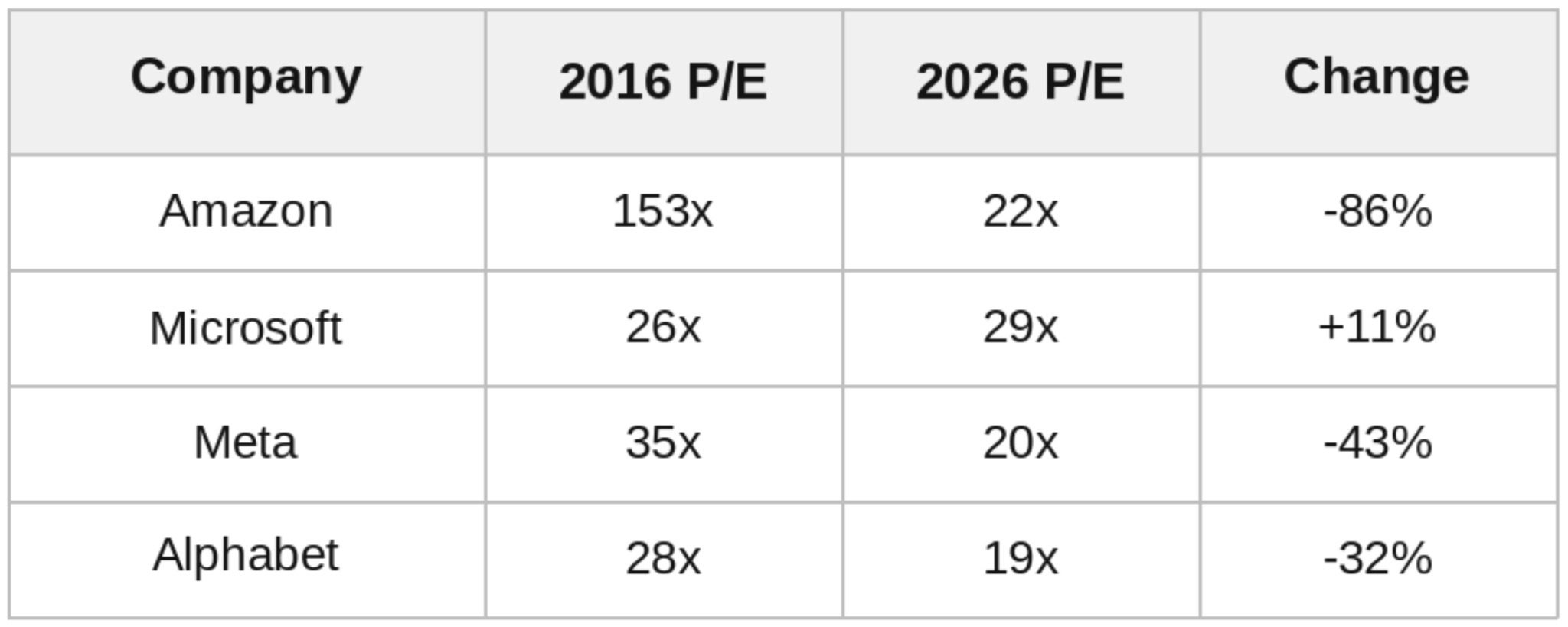
Many of the hyperscalers valuation multiples are lower today than they were a decade ago. Ten years ago, they were earlier in the growth curve. As more mature business today, requiring more reinvestment, investors are paying less for each dollar of earnings. So it makes sense that the multiples have come down. On this measure alone, it doesn’t look like a bubble.
Nvidia recently partnered with six asset managers to raise $500 billion for AI infrastructure buildout. Wall Street currently views data centers as expensive, risky, and unproven. The goal of the most recent deal is to de-risk them. Computing infrastructure is becoming a durable asset class with predictable cash flow, like commercial real estate.
Reasons to be skeptical
Michael Burry is a vocal bear. His argument is that hyperscalers inflate their earnings by depreciating hardware too slowly. Nvidia’s chips lose their edge for frontier training within 3 years, but are being depreciated over 5-6 years. He estimates this resulted in profits overstated by $176 billion.
The evidence is thin. Amazon actually shortened its useful life estimates in 2025 and Meta extended theirs. Nvidia argues that chips are still running at full utilization after six years. GAAP accounting rules give companies a great deal of discretion in how they report this. So it’s unlikely to be a sign of fraud.
Negative free cash flow has been central to the debate. Alphabet’s free cash flow turned negative for the first time since its 2004 IPO. Bank of America forecasts hyperscalers’ cash flow dropping from +$180 billion in 2025 to -$64 billion in 2026, then to -$144 billion in 2027 and -$186 billion in 2028.
But negative free cash flow is not inherently a bad thing. It means these companies are investing more than operations are currently bringing in. Sophisticated management teams don’t shovel hundreds of billions into infrastructure without having a strong reason to believe it will pay off. There are only a few uses for free cash flow (invest in growth, return to shareholders, or pay down debt), and investing aggressively in growth is one of the most bullish signals there is. Whether it results in the ROI they are hoping for remains an open question.
The hyperscaler build out is circular. Nvidia spends $100 billion with OpenAI, OpenAI spends $300 billion on a cloud contract with Oracle, and Oracle buys chips from Nvidia. Layering debt on top of this cycle makes it more fragile. Oracle carries negative $24 billion in free cash flow against $219 billion in liabilities.
Overvaluation most likely exists in the private markets. AI companies with no revenue are already being valued in the billions.
Disillusionment settles in
Hyperscaler capex has climbed to almost 100% today, from its normalized average of 40%. Capital allocators are betting that the demand eventually shows up. Here’s why it might not.
People overestimate AI’s impact on their tasks by 40 percentage points.
76% of companies believe they are ahead of their competitors on AI, but only 10% are seeing real ROI.
95% of generative AI pilots show no measurable financial impact.
A 2026 survey of 2,850 business leaders found that those who described their AI usage as “aggressive” declined from 60% to 42% y/y.
Nearly 70% of executives said they would cut their AI budgets if ROI targets were not met.
74% of companies that deployed AI agents in customer communications have rolled them back.
AI applications that have directly measurable impact are still likely to get funded. For example, coding tools are driving Anthropic’s growth.
Even if AI succeeds
There’s a separate reason a market correction could happen. AI’s uncertainty is a risk increasingly shared by the whole economy. It is not contained by just a few companies. A greater level of risk implies investors will demand a higher premium for holding it. That alone could pull valuations down. In this scenario, a market correction may happen even if everything goes well.
What to watch
Hyperscaler capex continues to climb while the customer demand is pulling back. Customers are capping budgets and cutting projects that don’t deliver measurable financial impact. If that gap doesn’t close, the first casualties will be companies with huge valuations but no revenue and companies that are over-leveraged.
On the other side, some profitable SaaS companies look underpriced on AI fears that haven’t, and perhaps won’t, materialize. More on that later – subscribe so you don’t miss it.