


I’ve been using AI to augment my investment research process for over a year. Models have changed (improved!) significantly during that period. Having extensively tested which tools and methods are effective, I wanted to share what my current workflow looks like.
The workflow is designed to separate the tasks AI is uniquely good at vs. what humans are uniquely good at. AI is excellent at gathering evidence, comparing sources, modeling scenarios, and pressure-testing assumptions. The investor is best suited to retain responsibility for judgement.
A core design principle is that consistency matters more than having a perfect prompt. Once calibrated, I use the same process and definitions across companies so the outputs are comparable. Even slight changes to prompts will produce vastly different outputs. Running each investment through the same process produces more comparable insights.
What I’m Looking For
I’m looking for companies that have room to become materially larger, have durable competitive advantages, and do not already have unachievable expectations priced in.
Keep in mind that there’s no such thing as a perfect investment. There are only those that fit your risk tolerance, time horizon, and goals better or worse. Advice from someone who doesn’t know your situation is close to worthless. I’m sharing this as an illustration of what works for my portfolio, not as a recommendation of how yours should look.
My workflow assesses business quality before it considers valuation. This is intentional. Determine which companies deserve a premium in the first place. Then consider what premium is fair.
The Workflow
The workflow follows these steps:
Primary Analysis
Model: GPT-5.6 Sol, High reasoning + current web search turned on
Output: Business quality, runway, reverse valuation, Bear/Base/Bull, risks
Independent Red Team
Model: Claude Opus 5.5, fresh context + web access
Output: Challenges assumptions, comparables, correlated risks, terminal valuation
Reconciliation
Model: GPT-5.6 Sol, High reasoning
Output: Adjudicated final targets, CAGR, permanent-loss risk, portfolio fit
Tracking
Tool: Master spreadsheet + individual stock tabs
Comparable opportunity set across the full research universe
Finalist Diligence
Model: GPT-5.6 Sol Deep Research
Extra diligence for top candidates or unresolved complex cases
How to Use the Outputs
The master spreadsheet is used as a comparison tool. I organize company-specific research on to individual tabs. The key metrics ladder up to an executive summary view that compares opportunities.
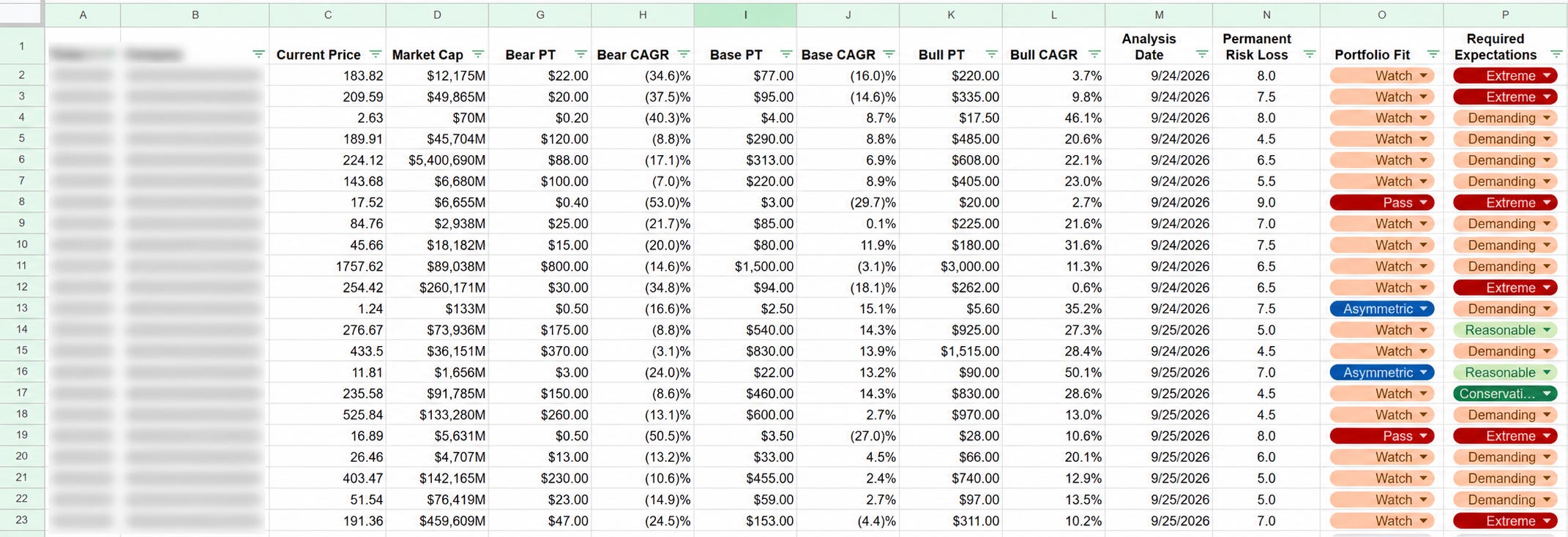
I prefer using Google Sheets because it allows me to link to other tabs for faster navigation. Using Google Finance formulas keeps the spreadsheet up-to-date with real-time market updates.
The outputs from the AI models’ research and analysis give me a few comparable metrics I use to evaluate investments.
Base, bear, and bull case targets.
Bear, base, and bull case targets are evaluated over a 5-year period. 1-year estimates tend to be heavily influenced by sentiment. A longer time frame is more difficult to predict reliably. Five years seems like a sweet spot.
Portfolio fit categories.
Pass: Economics, valuation, expected return, or risk make this investment unattractive.
Watch: An otherwise attractive business or opportunity, but the current valuation or an unresolved issue makes it unattractive at this time.
Compounder: This indicates a high-quality business with credible upside and acceptable permanent-loss risk.
Asymmetric: Outcomes are binary. Large upside potential coupled with meaningful permanent loss risk.
Permanent-loss Risk.
Scored on a scale of 1-10. The model is instructed not to conflate volatility with risk. Risk is defined as the probability of permanent loss. This is more appropriate for a longer-time-horizon investor.
Required Expectations.
A current stock prices reveals many combinations of expectations around growth, margin, dilution, and multiples. The reverse valuation exercise asks what operating performance would be required for an investor to earn a 10% annualized return over five years. This is used as a common measuring stick.
The Role of the Human Investor
AI is a good tool to use for gathering information, revealing embedded assumptions, and pressure-testing estimates. But it should not be used to make judgement calls. The final capital allocation decisions are left to the human. Once the AI analysis is complete, evaluate for yourself which assumptions are believable. Only you can decide how much risk you are willing to tolerate. Don’t leave those judgement decisions to AI.